
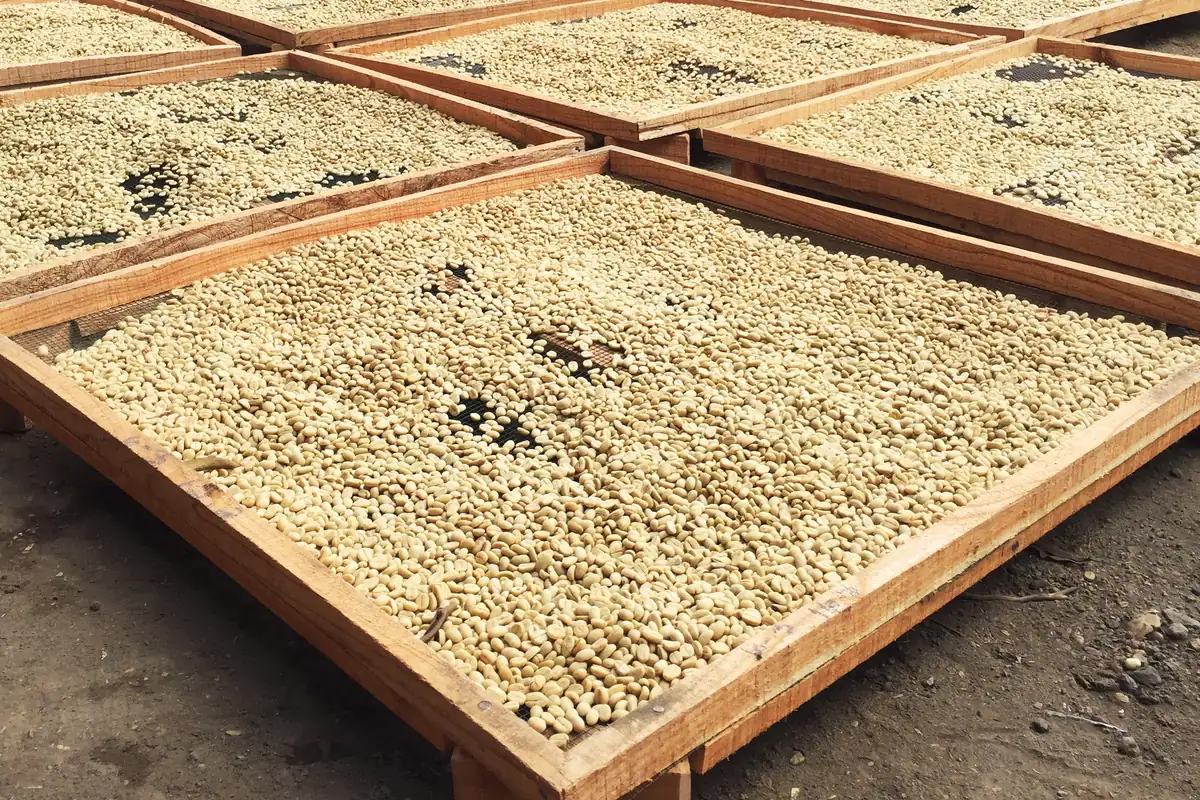
Java Ijen-Raung coffee is an arabica from the highlands of East Java, and it holds a special place in Indonesian coffee: “Kopi Arabika Java Ijen-Raung” carries registration number IG.00.2013.000001, the first entry on the national list of geographical indications. For green coffee buyers in Japan, China, Singapore, the UAE and Saudi Arabia, the name therefore signals a defined origin. This guide explains what the geographical indication covers, where the coffee grows, how it fits into Indonesia’s wider coffee crop, and what to check when an offer uses the Ijen-Raung name.
CV Sekawan Cipta Dinar works from Waru, Sidoarjo, East Java, close to Tanjung Perak in Surabaya.
This is a buyer’s guide to the origin. However, it does not mean we supply this GI coffee. For the general product picture, see Java coffee beans. For species differences, see Java robusta vs arabica.
A Registered Geographical Indication
Indonesia’s Directorate General of Intellectual Property (DGIP) lists “Kopi Arabika Java Ijen-Raung” with registration number IG.00.2013.000001, for the province of Jawa Timur (East Java). A geographical indication (GI) protects a product name linked to a defined area and to qualities that come from that area. In addition, the protected name belongs to the producers of that area as a group.
For a buyer, the GI means three things:
- the name “Java Ijen-Raung” refers to arabica from a defined area of East Java
- products sold in Indonesia under the protected name should meet the GI’s product description
- it is reasonable to ask for documentation that a lot sold under the name comes from that area
The GI is an Indonesian registration. As a result, protection in other countries depends on their laws and any separate registration.
Where Is Ijen-Raung?
The name joins two volcanic areas in the east of East Java: the Ijen plateau and Mount Raung. The area also spans several regencies in the eastern part of the province. Farmers here grow coffee at altitude, which is typical for arabica. For example, historical photographs in the Tropenmuseum collection show coffee estates on the Ijen plateau in the colonial period. In short, coffee has a long history in this landscape.
Other East Java Coffee GIs
Ijen-Raung is not the only coffee GI in East Java. The DGIP list also includes:
| Registered name | Area |
|---|---|
| Kopi Arabika Java Ijen-Raung (IG.00.2013.000001) | Ijen and Raung highlands, East Java |
| Kopi Arabika Java Hyang Argopuro | Argopuro mountain area |
| Kopi Robusta Java Argopuro Jember | Jember |
| Kopi Java Raung Gumitir Jember | Jember |
| Kopi Robusta Java Banyuwangi | Banyuwangi |
Our guide to the East Java coffee harvest season also covers these areas and the timing of the crop.
How Ijen-Raung Fits Indonesia’s Coffee Crop
Indonesia grows far more robusta than arabica. For instance, the USDA attaché office in Jakarta forecasts 2026/27 production at 11.38 million 60-kg bags, of which about 10 million are robusta and 1.38 million arabica. The same office also reports that most Indonesian arabica grows in the mountains of northern Sumatra, with smaller arabica crops in Java, Bali and Sulawesi.
| Item (2026/27 forecast) | Volume |
|---|---|
| Total green bean production | 11.38 million bags |
| Robusta | 10 million bags |
| Arabica | 1.38 million bags |
| Green bean exports | 7 million bags |
Java arabica, and a GI arabica within it, is therefore a small share of national supply. That matters for planning, because named-origin lots are limited and buyers tend to commit to them early.
When Is It Harvested?
USDA reports that robusta areas in East and Central Java have their main harvest between June and September, varying with microclimate and elevation. However, we did not find an official source giving exact harvest months for Ijen-Raung arabica, so we do not state them. Instead, ask the supplier for the picking dates of the lot on offer. Then agree the crop year in the contract.
What to Check When an Offer Says “Ijen-Raung”
- Origin documentation. Ask how the lot is linked to the GI area, for example through farmer group or cooperative records.
- Species. The GI is for arabica. So a robusta lot should not carry this name.
- Process. Ask whether the lot is washed, natural or another process, and how the producer dried it.
- Grade and defects. Agree the grade, defect count and screen size.
- Moisture. Agree a maximum and also ask for a reading before shipment.
- Crop year. Write the harvest year into the contract.
- Pre-shipment sample. Approve a sample taken from the actual lot.
- Bag marks. Finally, agree markings that match the documents.
Planning a Named-Origin Purchase
Because Java arabica is a small part of Indonesia’s crop, a named-origin lot needs more lead time than a standard grade. A simple plan looks like this:
- Send a brief early. First, share the species, origin, grade, process, quantity and shipping window well before the harvest.
- Review offer samples. Next, cup and grade the samples against your specification.
- Agree the contract. Then write the origin claim, crop year, grade, moisture and documents into the contract.
- Approve the pre-shipment sample. Confirm that the lot you will ship matches the offer sample.
- Book and ship. Finally, align the certificate of origin and phytosanitary certificate with the booking.
Notes for Each Market
Specialty roasters in Japan often want a clear origin story and consistent lots across several years. Therefore, ask about continuity of supply. Buyers in China and Singapore may combine a GI arabica with other Indonesian coffees in a range, so agree how you will label each product. Meanwhile, in the UAE and Saudi Arabia, cafés and specialty retailers sell much of the coffee. There, documentation that supports the origin claim helps retail partners present the product accurately.
Using the Name on Your Own Packaging
If you roast and sell coffee under the Ijen-Raung name, keep the origin documents for each lot. In addition, check your own market’s labelling rules for origin claims. Using a protected regional name loosely, for example on a blend that only contains a small part of GI coffee, can mislead customers. It may also break rules in some markets.
Shipping Green Arabica from East Java
Green arabica from East Java usually leaves through Tanjung Perak in Surabaya. Moisture control, clean containers and good liners matter on longer routes to the Middle East. For this reason, our guide to shipping green coffee beans covers packing and container conditions. Similarly, Surabaya to Jeddah shipping time gives the quickest scheduled transit times to Jeddah, Dubai and Tokyo.
Documents for Each Shipment
| Document | What it does |
|---|---|
| Certificate of origin | Proves Indonesian origin for duty; it does not certify the GI area |
| Phytosanitary certificate | Confirms plant health inspection; see our phytosanitary certificate guide |
| Origin or traceability records | Support the Ijen-Raung claim |
| Quality report | Grade, defects and moisture for the lot |
For the import process step by step, see how to import coffee beans from Indonesia. In addition, China buyers can read the Form E certificate of origin guide for preferential duty documents.
Who Grows It
USDA reports that smallholders, typically farming one to two hectares, account for about 98 percent of Indonesia’s coffee area. It also reports that a state-owned enterprise in East Java manages a large robusta plantation. Most Indonesian coffee therefore reaches exporters through farmer groups, collectors and processors. For a GI coffee, this chain is where people keep the origin records, so ask how the lot moved from farm to warehouse. In practice, a supplier who can explain each step, from the farmer group to the dry mill to the export warehouse, is usually also the one who can deliver consistent quality.
Request a Quote
Send the species, origin preference, grade, process, quantity, destination port and shipping month. Then we reply within 24 working hours with a proforma invoice to review.
- Quote form: sekawanciptadinar.id/#order
- WhatsApp: +62 852-3001-7377
- Email: inquiry@sekawanciptadinar.id
Also, review the published figures on our coffee product listing before you send the inquiry.
Sources
- DGIP Indonesia, Geographical Indication listing (Kopi Arabika Java Ijen-Raung, IG.00.2013.000001). Link. Last checked 26 Okt 2026.
- USDA FAS GAIN, Indonesia Coffee Annual 2026, report ID2026-0021. Link. Last checked 26 Okt 2026.
- USDA FAS GAIN, Indonesia Coffee Semi-annual 2025, report ID2025-0039. Link. Last checked 26 Okt 2026.
Frequently Asked Questions
What is Java Ijen-Raung coffee?
It is arabica coffee from the Ijen and Raung highlands of East Java. Indonesia registers it as the geographical indication Kopi Arabika Java Ijen-Raung.
What is the GI number for Java Ijen-Raung?
DGIP lists it as IG.00.2013.000001, for the province of Jawa Timur. In fact, it is the first number on the national GI list.
Is Ijen-Raung coffee arabica or robusta?
The registered GI is for arabica. By contrast, producers sell East Java robusta under other names, such as the Banyuwangi and Argopuro Jember robusta GIs.
When is Ijen-Raung coffee harvested?
We found no official source with exact harvest months for Ijen-Raung arabica. However, USDA reports a June to September main harvest for East Java robusta. So ask the supplier for the lot’s picking dates.
How can I check that a lot is genuine Ijen-Raung?
First, ask for origin or traceability records linking the lot to the GI area. Then approve a pre-shipment sample, and agree the claim in writing in the contract.