
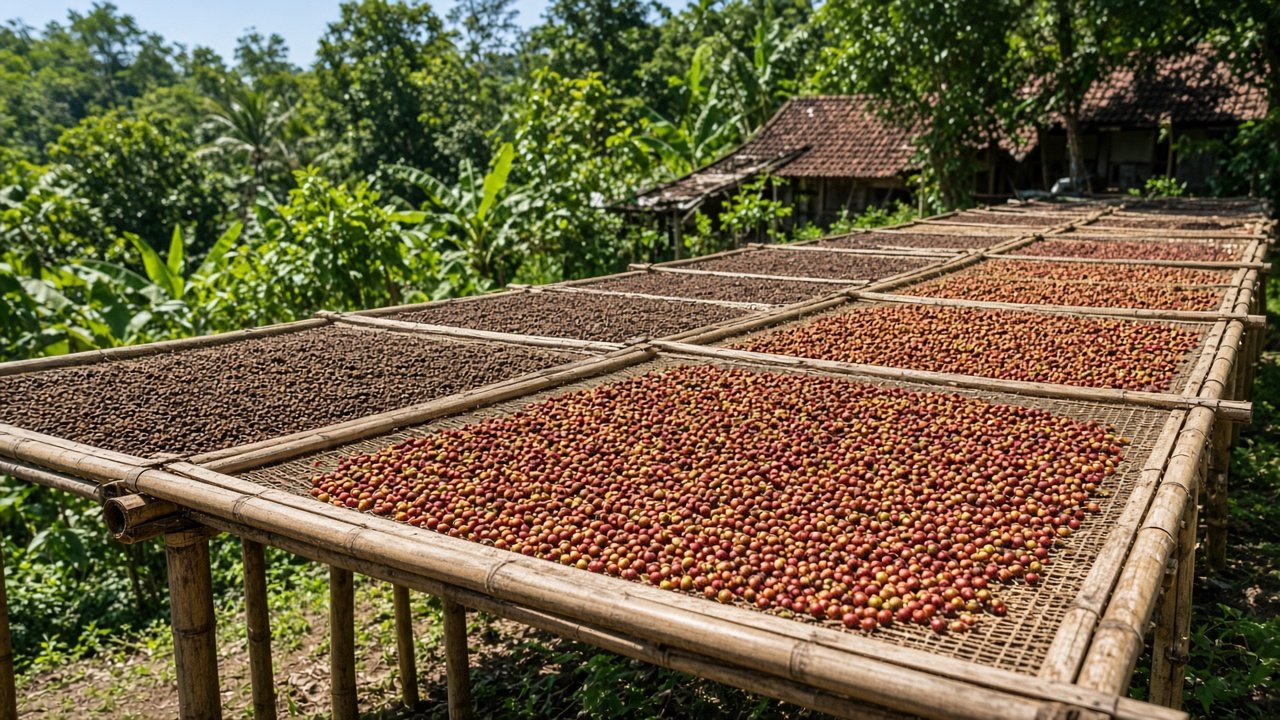
Java coffee beans carry one of the oldest names in the coffee trade. Coffee has grown on the island for more than three centuries. However, most articles about it target home brewers, not buyers who purchase by the container. This guide is for importers, roasters, wholesalers and food manufacturers in Japan, China, Singapore, the UAE and Saudi Arabia. In short, it explains Java Robusta and Java Arabica before you request a quote.
CV Sekawan Cipta Dinar exports Indonesian coffee beans, spices and agricultural commodities. We work from Waru, Sidoarjo, East Java, close to Tanjung Perak port in Surabaya. From there, we supply Java Robusta and Java Arabica green beans as Grade A. In addition, we sort them following the Indonesian National Standard (SNI) for coffee beans, and you can ask for the lab analysis of your lot. Our coffee product listing summarises the range. If you are new to sourcing from Indonesia, start with our guide on how to import coffee beans from Indonesia.
Java Coffee Beans at a Glance
| Item | Summary |
|---|---|
| Species offered | Java Robusta green beans (Coffea canephora) and Java Arabica green beans (Coffea arabica) |
| Origin | Java, Indonesia |
| Grade | Grade A, sorted following SNI |
| Processing | Six-step process (see below), dried to 11–12% moisture; method confirmed per lot |
| MOQ | 19 tonnes (one 20-ft container) |
| Main robusta harvest (East and Central Java) | Generally June–September (USDA FAS) |
| HS subheading | 0901.11 (coffee, not roasted, not decaffeinated) |
A Short History of Java Coffee
The Dutch East India Company (VOC) brought arabica to Java from Malabar, India, in the late 1690s. The first seedlings reached Batavia in 1696, but floods destroyed them. A second shipment in 1699 took root. Then, in 1711, the VOC shipped the first Java coffee to Europe. By the mid-19th century, “java” had become a slang word for coffee in English.
In the late 19th century, Java was one of the world’s leading coffee origins. From the late 1870s, coffee leaf rust (Hemileia vastatrix) spread across the island and destroyed much of its lowland arabica. As a result, Java’s share of world coffee exports fell sharply.
Recovery took two routes:
- Robusta in the lowlands. Planters tried liberica first. Then, around 1900, robusta seeds from the Congo reached Java via Brussels, according to World Coffee Research. Robusta then spread through East Java, especially at lower altitudes. Indonesia also ran the first systematic robusta breeding programmes.
- Arabica in the highlands. On East Java’s Ijen plateau, Dutch planters opened arabica estates from the 1890s onward, and they still produce coffee today. Meanwhile, in West Java, the Priangan highlands (“Preanger” in Dutch) were the historic home of “Java coffee”.
Java Robusta Coffee Beans: Growing Areas and Cup Profile
Where Java Robusta Grows
Indonesia’s largest robusta belt is in southern Sumatra (Lampung, South Sumatra and Bengkulu). By contrast, Java is a smaller robusta origin, but a long-established one. In East Java, robusta grows in regencies such as Malang (including Dampit), Banyuwangi, Jember, Bondowoso, Lumajang and Pasuruan.
Registered Geographical Indications (GIs) for Java robusta include Kopi Robusta Temanggung (Central Java, 2016), Kopi Robusta Java Bogor (West Java, 2019), Kopi Robusta Pasuruan (East Java, 2019) and, more recently, Kopi Robusta Java Banyuwangi (East Java). These are general growing areas, not the origin of any specific lot we offer.
USDA FAS reports that smallholders, typically farming 1–2 hectares, hold about 98% of Indonesia’s coffee area. Therefore, exporters consolidate each lot from many farms. For this reason, the exporter’s sorting and grading matter. The main robusta harvest in East and Central Java generally runs from June to September.
Java Robusta Taste
World Coffee Research describes robusta as generally lower in acidity, more bitter and fuller-bodied than arabica. In addition, it has more caffeine and more soluble solids, the compounds that dissolve into the brew. Trade notes often describe Java robusta as chocolate, cocoa, nutty, woody or spicy. Our product page describes our coffee as earthy and spicy, with a thick body and a strong, bitter taste. Still, the cup depends on the lot, processing and roast. So cup the coffee against your own blend targets before committing to volume.
Java Arabica: A Small Highland Origin
Java arabica is a small, highland crop. USDA FAS reports that Indonesian arabica is concentrated in Aceh and North Sumatra. In contrast, smaller volumes come from the highlands of Java, Sulawesi and Papua.
Registered GIs for Java arabica include:
- Kopi Arabika Java Preanger: the Priangan highlands of West Java, GI since 2013.
- Kopi Arabika Java Ijen-Raung: the Ijen and Raung highlands of Bondowoso, Situbondo and Banyuwangi in East Java, GI since 2013.
- Kopi Arabika Java Sindoro Sumbing: Central Java, GI since 2014.
Only registered producers inside each GI area may use these GI names. We list them to show where Java arabica grows, not to describe the origin of our lots. We offer our coffee as Java Arabica Grade A. However, Java arabica volumes depend on the harvest, so confirm availability for your order in the quotation.
Trade notes typically describe washed Java arabica as a clean cup with good to heavy body and low to delicate acidity. Sweetness, chocolate and spice notes are common. Trade writers contrast it with the earthier profile of wet-hulled Sumatra coffee beans. Note that these are typical descriptors, not a specification.
How Our Java Coffee Is Processed
Our Java coffee goes through six steps:
- Cherry sorting. We separate fully ripe red cherries from green, rotten or pest-damaged fruit.
- Pulping. A pulper removes the outer fruit from the beans.
- Fermentation and washing. The beans rest, dry or under water, for 12–36 hours to break down the mucilage (the sticky layer around the bean). After that, we wash them clean.
- Drying. Next, we dry the parchment coffee in the sun or in mechanical dryers to 11–12% moisture.
- Hulling. A huller removes the dry parchment to produce green beans.
- Final sorting and grading. First, we separate the beans by size. Then we remove defective beans by hand or with a colour sorter, with the aim of meeting international standards.
Pulping (step 2) applies to the wet and semi-wet methods. Ask us to confirm the processing method of your lot in the quotation.
Java Coffee Specifications: Grade A, Bean Size and SNI
Our Java Robusta and Arabica Specification
| Parameter | Java Robusta | Java Arabica |
|---|---|---|
| Species | Coffea canephora | Coffea arabica |
| Origin | Java, Indonesia | Java, Indonesia |
| Grade | Grade A, sorted following SNI | Grade A, sorted following SNI |
| Bean size | Large, medium and small classes (see below) | About 6.0 mm to over 7.0 mm (see below) |
| Processing | Six-step process; method confirmed per lot | Six-step process; method confirmed per lot |
| Moisture | Dried to 11–12%; max 12% | Dried to 11–12%; max 12% |
| Documents | Certificate of Origin, laboratory analysis, phytosanitary certificate | Same |
| MOQ | 19 tonnes (one 20-ft container) | 19 tonnes (one 20-ft container) |
What “Grade A” Means
SNI 2907:2008 Biji kopi (first published as SNI 01-2907-2008) is Indonesia’s national standard for robusta and arabica green beans. According to the Association of Indonesian Coffee Exporters and Industries (AEKI), the National Standardization Agency (BSN) reconfirmed it in 2026 after a review. Therefore, the 2008 limits remain the reference.
The standard requires no live insects, no rotten or mouldy smell and a moisture content of at most 12.5%. It also sets a limit for foreign matter. Graders then score each lot by defect value. This score counts the number and type of defective beans in a 300 g sample. Grades run from 1 (fewest defects) to 6, with robusta grade 4 split into 4a and 4b.
SNI has no grade called “A”. Instead, Grade A is our own grade name for the green beans we export. We sort them following SNI, and you can ask for the laboratory analysis of your lot. Our 11–12% drying target and 12% maximum moisture sit inside the SNI limit of 12.5%. If your contract requires a specific SNI grade or defect limit, state it in your request. We can then discuss it in the quotation.
Bean Size (Screen Size)
| Species and class | Round-hole screen |
|---|---|
| Robusta, large | Does not pass 7.5 mm |
| Robusta, medium | Passes 7.5 mm, retained on 6.5 mm |
| Robusta, small | Passes 6.5 mm, retained on 5.5 mm |
| Arabica | About 6.0 mm to over 7.0 mm |
We give sizes in millimetres for round-hole screens. If you buy by screen number (the hole diameter in 64ths of an inch), tell us the screen you need. We will then confirm the matching size in the quotation.
Our three robusta classes use the same 7.5, 6.5 and 5.5 mm round-hole sieves that SNI sets for wet-processed robusta. SNI allows up to 5% by mass of each class to pass the lower sieve. It also lets buyer and seller agree on other sizes. For that reason, please state your screen requirement in your inquiry.
How Java Robusta and Arabica Are Used in Japan, China, Singapore and the Gulf
World Coffee Research links much of the growth in robusta demand to soluble coffee and blends, where body and soluble solids count. Arabica, on the other hand, goes mainly into roast-and-ground and café coffee.
- Japan: JETRO’s export guidebook (2011) noted that Indonesian robusta in Japan went mainly into processed coffee, such as instant and canned drinks. By contrast, Indonesian arabica went into regular coffee.
- China: a 2022 USDA report cited industry estimates that Chinese consumers drank instant coffee about 70% of the time. However, the market was shifting quickly toward cafés and fresh coffee.
- Singapore: Nanyang kopi is traditionally robusta-led, with some arabica and occasionally liberica. Roasters cook the beans with margarine, sugar and salt. Then they brew the coffee through a cloth “sock” and serve it with condensed milk. As a result, Singapore roasters who buy green coffee beans for kopi can use Java robusta for body.
- UAE and Saudi Arabia: for coffee wholesale buyers in Dubai and Riyadh, robusta can add body and crema to espresso blends. Meanwhile, washed arabica suits filter and single-origin menus.
Indonesian coffee beans already reach all five markets. The WITS/UN Comtrade 2024 figures below (HS 090111) cover all Indonesian green coffee. In other words, they include arabica and robusta from every island, not Java alone.
| Destination | Value (US$ million) | Volume (tonnes) |
|---|---|---|
| All markets | 1,623.1 | 312,747 |
| Japan | 89.0 | 15,259 |
| China | 48.4 | 8,031 |
| Singapore | 20.1 | 4,393 |
| UAE | 17.0 | 3,212 |
| Saudi Arabia | 4.1 | 500 |
How to Order Java Coffee Beans
- Send your specification: species (robusta or arabica), screen size, required grade or defect limits, quantity, packing, destination port and Incoterm. Our MOQ is 19 tonnes, one 20-ft container.
- Request a quotation through our quote form, and ask about sample availability and terms.
- Quality control: your lot goes through our four QC layers. These are partner-farmer procurement and pre-sorting, cleaning and drying, laboratory testing with a QC report, and packing with export documents.
- Packing: options include vacuum, bulk, aluminium foil, kraft and PP bags.
- Documents: these include a Certificate of Origin, laboratory analysis, a phytosanitary certificate where your market requires it, and an MSDS. If you need a preferential Certificate of Origin form, tell us which one.
Import Rules by Market
Import rules differ by market. For example, in Japan green coffee generally goes through plant-quarantine inspection and a food import notification. In China, overseas exporters of green coffee generally need to register with the customs authority (GACC).
In Singapore, the Singapore Food Agency controls food imports. Similarly, in the UAE, MOCCAE and emirate authorities such as Dubai Municipality do so. Finally, in Saudi Arabia, the Saudi Food and Drug Authority is in charge. Requirements change, so confirm current rules with your customs broker or the relevant authority before shipping. For the full process, see our guide on how to import coffee beans from Indonesia.
Request a Quote for Java Coffee Beans
We supply green coffee beans wholesale, by the container, to importers, roasters and manufacturers. Tell us what the beans are for: Java robusta coffee beans for espresso blends, instant coffee, ready-to-drink (RTD) beverages or kopi, or Java arabica for roast-and-ground coffee. Send your specification and target volume, and review our Java coffee specifications if you need them. We will then reply with a quotation that states the grade, screen size, lot details and packing options.
We also supply Liberica green beans and coffee powder; origin and specifications on request.
- Quote form: sekawanciptadinar.id/#order
- WhatsApp: +62 852-3001-7377
- Email: inquiry@sekawanciptadinar.id
Also sourcing spices? Read our guide to Lalpari cloves, or browse cloves and cinnamon on our products page.
Frequently Asked Questions
What is the minimum order for Java coffee beans?
Our MOQ is 19 tonnes, which fills one 20-ft container. We confirm price and lead time in the quotation.
What does “Grade A” mean?
Grade A is our own grade name, not one of the numbered SNI grades (1 to 6). We sort our beans following the Indonesian National Standard (SNI) for coffee beans, and you can ask for the laboratory analysis of your lot. In addition, we can discuss contract limits, such as a maximum defect value, in the quotation.
Is Java coffee always robusta?
No. Arabica came to Java first, in the 1690s. Robusta arrived later, around 1900, and grows mostly at lower elevations. As a green coffee beans supplier, we offer both Java Robusta and Java Arabica.
Which bean sizes can you supply?
Java Robusta comes in three classes: large (does not pass a 7.5 mm screen), medium (7.5–6.5 mm) and small (6.5–5.5 mm). Java Arabica is about 6.0 mm to over 7.0 mm.
Which documents come with a shipment?
We provide a Certificate of Origin, a laboratory analysis certificate and a phytosanitary certificate where your market requires it. An MSDS is also available. Finally, the beans ship under HS code 0901.11.