
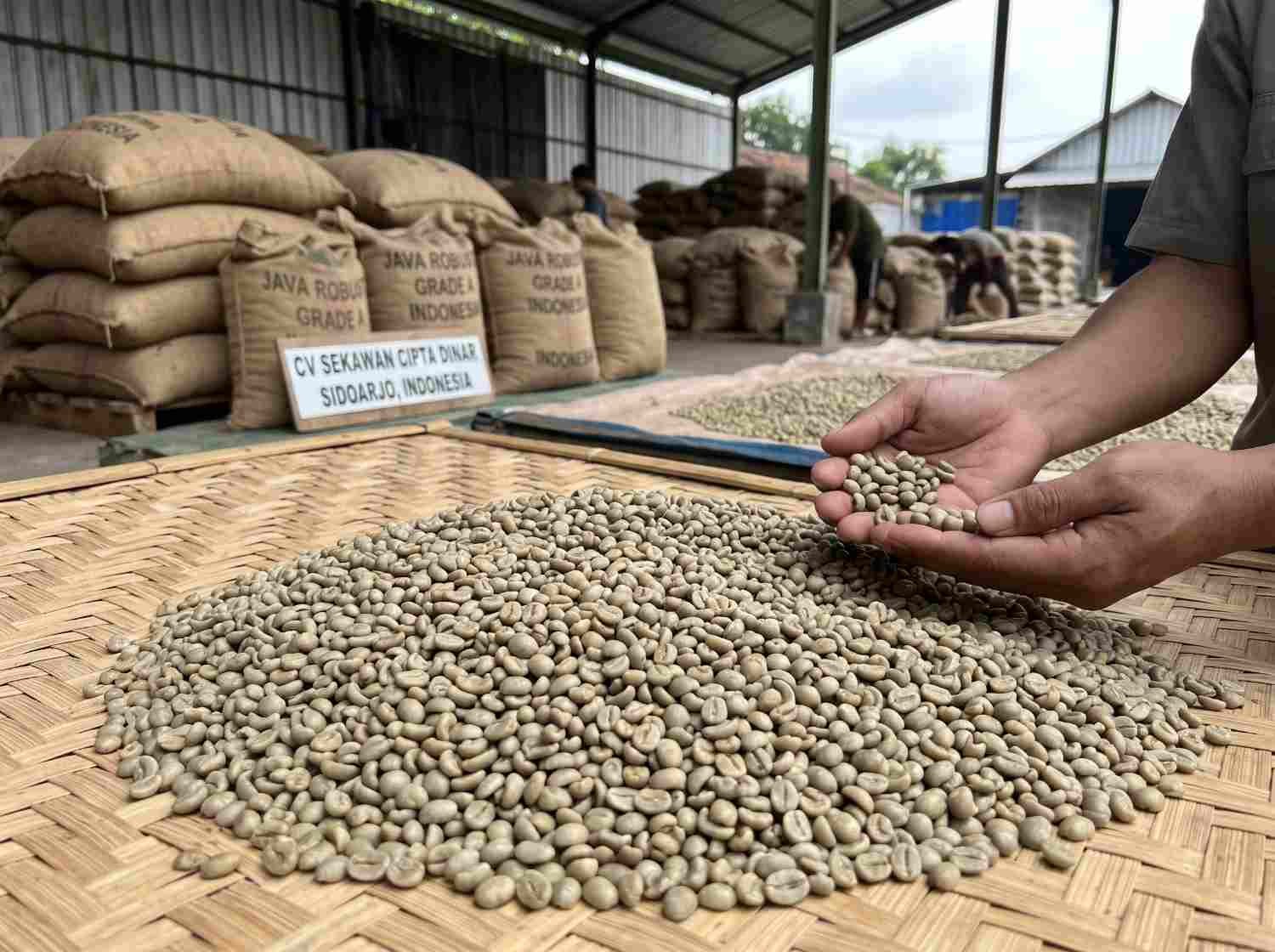
Java Robusta vs Arabica is a buying decision before it is a tasting note. The two species are both grown on Java, both leave our warehouse as green beans, and both can be Grade A. They are not interchangeable in a blend, in a screen-size contract, or in the way a roaster uses them. This guide is for importers, roasters, and food manufacturers across Asia and the Middle East. It helps you choose between the two species, or order both with clear specifications.
CV Sekawan Cipta Dinar exports from Waru, Sidoarjo, East Java. This location is near Tanjung Perak in Surabaya. The full origin story and the SNI grade table are in our Java coffee beans guide. Moreover, you can find the documents, Incoterms, and destination rules in how to import coffee beans from Indonesia. Here, we only compare the two beans we offer.
Java Robusta vs Arabica at a Glance
| Item | Java Robusta | Java Arabica |
|---|---|---|
| Species | Coffea canephora | Coffea arabica |
| Origin we state | Java, Indonesia | Java, Indonesia |
| Grade name | Grade A, sorted following SNI | Grade A, sorted following SNI |
| Round-hole screen | Large: retained on 7.5 mm. Medium: passes 7.5 mm, retained on 6.5 mm. Small: passes 6.5 mm, retained on 5.5 mm | About 6.0 mm to over 7.0 mm. We agree on the exact range in the contract. |
| Moisture | Dried to 11–12%, maximum 12% | Dried to 11–12%, maximum 12% |
| MOQ | 19 tonnes (one 20-ft container) | 19 tonnes (one 20-ft container) |
| HS subheading | 0901.11 (not roasted, not decaffeinated) | 0901.11 (not roasted, not decaffeinated) |
Grade A is our commercial name. Therefore, it is not an SNI grade number. SNI 2907:2008 grades beans from 1 to 6 by the defect value in a 300 g sample, and its moisture ceiling is 12.5%. Our drying target sits safely inside that ceiling. If you need a numbered SNI grade or a maximum defect value, please write it into your inquiry. We can then discuss the laboratory analysis against your requirements.
Where the Two Crops Sit on Java
Indonesia’s largest robusta belt is in southern Sumatra. However, Java is a smaller, long-established robusta origin. Farmers grow East Java robusta in areas such as Malang, Banyuwangi, Jember, Bondowoso, Lumajang, and Pasuruan. The main robusta harvest in East and Central Java generally runs from June to September. On the other hand, Arabica on Java is a highland crop. It represents a small share of Indonesia’s arabica production.
Registered geographical indications exist for both species on Java. We list growing areas so buyers can see the map. However, we do not sell our lots under those GI names. The contract origin we offer is Java Robusta Grade A or Java Arabica Grade A. Furthermore, Arabica volume heavily depends on the harvest. Therefore, we will confirm its availability in the quotation.
How the Cup and the Factory Use Differ
World Coffee Research describes robusta as generally lower in acidity, more bitter, and fuller-bodied than arabica. It also contains more caffeine and more soluble solids. Our product page describes the coffee we ship as earthy, with typical spice notes, a thick body, and a strong bitter taste. However, that is a product description, not a cupping score. We highly recommend you cup the lot against your own target before committing to a container.
Here are typical uses, though we do not promise that every lot will taste exactly the same:
- Java Robusta is the usual choice for instant coffee, ready-to-drink beverages, and espresso blends that need body and crema. It is also perfect for traditional kopi that is roasted dark and brewed with condensed milk. In Singapore, Nanyang kopi is traditionally robusta-led. Meanwhile, in Japan, Indonesian robusta has long gone into processed coffee.
- Java Arabica is the usual choice for roast-and-ground coffee and for café menus that want a cleaner cup. Trade notes often mention a heavier body than a washed Central American arabica. Typical descriptors include low to delicate acidity, sweetness, chocolate, or spice. Remember, these are typical descriptors rather than a strict specification.
If your brief says only “Java coffee”, please clarify which species you need. If a roaster wants arabica but receives robusta, they have the wrong bean even when the grade name matches.
Screen Size Is Not the Same Contract
We offer robusta in three classes, while we offer arabica as a range. Please write the class in millimetres in your inquiry. Do not only use the word “large” or a screen number in 64ths of an inch. Screen numbers do not convert exactly to round-hole millimetres. Therefore, the millimetre size governs the contract.
| What to write in the inquiry | Robusta example | Arabica example |
|---|---|---|
| Species | Java Robusta | Java Arabica |
| Size | Medium: passes 7.5 mm, retained on 6.5 mm | Retained on 6.0 mm, up to beans over 7.0 mm |
| Moisture | Maximum 12%, method stated on the lab analysis | Maximum 12%, method stated on the lab analysis |
| Defects | SNI defect value, if you require a ceiling | SNI defect value, if you require a ceiling |
| Use | Instant, blend, RTD or kopi | Roast-and-ground or filter |
Our three robusta classes use the 7.5, 6.5, and 5.5 mm round-hole limits. SNI sets these limits for wet-processed robusta. We will confirm the processing method of each lot in our offer. This could be the wet or semi-wet path in our six steps, or another method. Note that pulping applies to the wet and semi-wet methods only.
Ordering One Species or Both
The minimum order is 19 tonnes, or one 20-ft container, for each species we contract. At that weight, we usually load about 317 bags of 60 kg. We floor-load them or use a bulk liner. The loaded weight depends on the packing type, and we confirm this in the quotation.
We process the beans through six main steps. First, we sort fully ripe red cherries. Second, we pulp them if the chosen method requires it. Third, we ferment and wash the beans for 12 to 36 hours. Next, we dry the parchment to 11–12% moisture. After that, we hull the beans. Finally, we sort them by size and defects using hands or a colour sorter. We apply the same four QC layers to both species: partner-farmer procurement, cleaning and drying, laboratory reporting, and export packing.
We provide standard documents for both species. These include a certificate of origin, a laboratory analysis, and a phytosanitary certificate if the destination requires it. Japan currently exempts unroasted coffee beans from exporting country phytosanitary certificates. However, the importer still files the Japanese plant and food notifications. If you need ochratoxin A, pesticide residues, or a preferential origin form, please state them in the inquiry.
A mixed container of robusta and arabica is a different contract from two full containers. Please tell us if you want to discuss this option. Do not assume you can split the MOQ across species unless the quotation explicitly says so. Additionally, green coffee picks up odours easily. If you also buy our Lalpari cloves, please keep that booking separate. We only combine them if we agree on sealed packs and separate stowage.
Which One to Request
- Choose Java Robusta when your specification is body, soluble solids, crema, or a dark traditional roast. Also, choose this when you can name a specific screen class.
- Choose Java Arabica when your specification is a cleaner roast-and-ground cup. You must also accept that we confirm volume based on the harvest.
- Request both quotations when your blend needs a named ratio. Price them as two separate lots with two screen sizes, even if they sail in the same month.
We can also discuss Liberica green beans and coffee powder. We do not publish their specifications on this page. Simply ask us, and we will explain what is available.
Request a Quote
Send us the species, the screen size in millimetres, any defect or moisture ceiling, and the quantity. Also include the pack type, the Incoterm, and the destination port. We will reply with a quotation stating the grade, size, and documents.
- Quote form: sekawanciptadinar.id/#order
- WhatsApp: +62 852-3001-7377
- Email: inquiry@sekawanciptadinar.id
Please review the published figures on our coffee product listing before sending your inquiry. This ensures your request matches the beans we actually ship.
Frequently Asked Questions
Is Grade A the same for Robusta and Arabica?
Grade A is our commercial name for both species. It is not a formal SNI grade. The laboratory analysis of the lot shows the measured results. You should include any specific SNI grade or defect ceiling you need in the contract.
What is the minimum order?
The minimum is 19 tonnes, or one 20-ft container, for the contracted species. Packing methods will change the final loaded weight, and we will confirm this in your quotation.
Which screen sizes can I specify?
For Robusta, you can choose large (retained on 7.5 mm), medium (7.5–6.5 mm), or small (6.5–5.5 mm). For Arabica, the range is about 6.0 mm to over 7.0 mm. We will agree on the exact range in the final contract.
Do both species use the same moisture limit?
Yes. We dry both species to 11–12%, with a strict maximum of 12%. The SNI standard actually allows up to 12.5%.
Can I order Liberica or coffee powder instead?
Yes, just ask us. We can discuss both options. We will confirm the specification per inquiry rather than taking it from the standard Robusta and Arabica table.