
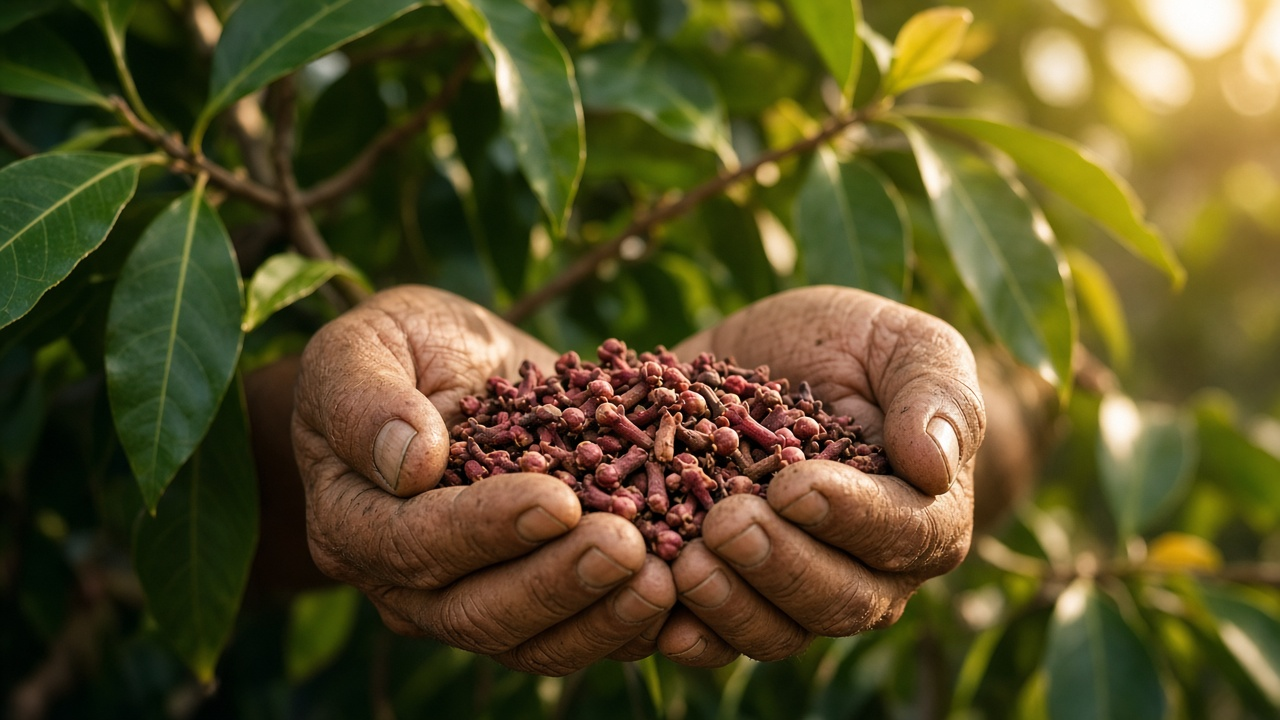
A clove specification only protects the buyer when every number means the same thing on both sides of the contract. “Premium”, “hand-picked” and a trade name do not settle an arrival claim. Volatile oil, moisture, stems, foreign matter and the defects you are willing to accept do. This checklist is for importers, grinders and food manufacturers who already know they want Indonesian cloves and now need to read an offer without guessing.
The steps from inquiry to clearance are in our guide on how to import cloves from Indonesia. The trade name Lalpari, the harvest and the dishes that use the spice are in the Lalpari cloves buyer’s guide. Use this page as the sheet you fill in before you accept a price.
The Six Lines Every Offer Should Answer
Our published specification for Lalpari cloves covers the lines below. Ask any other supplier for the same lines, in the same units, before you compare prices.
| Line on the spec | What to check | Our published figure |
|---|---|---|
| Form | Whole buds, or crushed/ground. The HS code changes with the form | Whole Lalpari cloves |
| Volatile oil | The percentage, and the method if your lab requires one | 18–21% |
| Moisture | The range, not a single word such as “dry” | 8–12% |
| Foreign matter | Dust, leaf and anything that is not clove | 0.5–1% |
| Stems | A separate line from foreign matter. Stems are clove, but they are not buds | 1–2% |
| Colour and aroma | What the lot should look and smell like on a white sheet of paper | Rich reddish-brown; strong aroma |
If a quotation leaves one of these lines blank, the blank is a missing term, not a promise of a better lot.
Volatile Oil, and When to Ask for Eugenol
Volatile oil is the figure that tracks aroma. Eugenol is the main component of that oil. Published ranges put eugenol at roughly 72–90% of clove essential oil, which is why oil distillers, toothpaste makers and fragrance buyers sometimes ask for eugenol as well as total oil. Our published range is the total volatile oil, 18–21%. That sits at or above the 18% oil level associated with the Lalpari name in the Indian trade. It is not, by itself, a eugenol guarantee.
If your application needs a eugenol result, write the method and the minimum into the inquiry. We will say whether the certificate of analysis for that lot can report it. Do not add a eugenol number to a contract that the COA will not test.
Defects That a Percentage of “Foreign Matter” Does Not Catch
Foreign matter and stems are not the only things a receiver should look for. Three further terms belong in a spice contract when the buyer’s standard requires them:
- Mother cloves are the ripe fruits. They are larger and weaker in aroma than the unopened bud.
- Blown cloves are flowers that opened and lost their petals. The head the buyer paid for is no longer intact.
- Exhausted cloves are buds that have already had their oil distilled out. They can look like spice and smell of almost nothing.
We do not publish a numerical limit for these three. If your own buyer does, copy that limit into your inquiry so it can be discussed before the proforma invoice. A QC report that only repeats moisture and oil will not answer a claim about exhausted cloves unless those parameters were agreed.
A Short Arrival Check
You can do this on a sample and again on the arrival lot. It does not replace a laboratory oil test. It does show whether the lot matches the words on the spec.
- Paper test. Spread 50–100 g on white paper. Count stems and pick out dust, leaf and stones. The stem line and the foreign-matter line are separate.
- Head test. Most buds should still have a round head. A pile of open, petalless flowers is a blown-clove problem, not a colour problem.
- Crush test. Crush a few buds. A strong, clean smell supports the oil line. A musty smell is a storage or moisture problem. Almost no smell is a reason to stop and ask for the oil result before you grind the lot.
- Match the paper to the COA. The batch number on the bag and the batch number on the certificate should be the same lot.
Our batches go through procurement and pre-sorting, cleaning and drying, a lab test with a QC report, and then packing. A COA is available on request. Ask for it against the lines in the table, plus any extra defect limits you added.
Moisture Is a Storage Term, Not Only a Lab Term
Moisture of 8–12% is the published window. Wetter cloves mould more readily and you pay freight on water. Very dry, dusty lots can mean rough handling or a long time in the open. Either way, the number belongs next to the pack type. Vacuum packs, aluminium foil, kraft bags, PP bags and bulk packing do not protect the oil equally. Say which pack you need, and whether the cloves will be ground soon after arrival or stored.
Whole cloves keep their oil longer than ground cloves. If you import whole buds under HS 0907.10 and grind them in your own plant, write “whole, neither crushed nor ground” on the inquiry so the invoice, the certificate and the tariff line all say the same thing. Ground cloves are HS 0907.20.
What Not to Treat as a Specification
- A trade name alone. Lalpari tells an experienced buyer to expect Indonesian cloves with a reddish-brown colour and a strong aroma. It does not replace the oil, moisture, stem and foreign-matter lines.
- A grade code the contract does not define. If a code is not followed by the four numbers above, ask what it means in oil, moisture, stems and foreign matter. Do not assume two sellers use one code the same way.
- A price per kilogram with no pack and no incoterm. FOB Surabaya and CIF your port are different offers. So are a vacuum pack and a plain PP bag.
Copy This into Your Inquiry
You can paste the block below into our quote form, a WhatsApp message or an email. Fill the brackets.
- Product: whole Indonesian cloves (Lalpari), not ground
- Volatile oil: 18–21%, or your own minimum if it is tighter
- Moisture: 8–12%
- Foreign matter: 0.5–1%
- Stems: 1–2%
- Extra limits, if any: mother cloves / blown cloves / exhausted cloves / eugenol
- Quantity, pack, Incoterm, destination port
- Documents: COA parameters, phytosanitary certificate, certificate of origin, MSDS if required
We reply within 24 working hours. The same inquiry can mention Java coffee if you buy both, with a note on whether they must ship in separate containers. Cloves are aromatic and green coffee takes on odours.
- WhatsApp: +62 852-3001-7377
- Email: inquiry@sekawanciptadinar.id
Frequently Asked Questions
Which four numbers should a clove contract always show?
Volatile oil, moisture, foreign matter and stems. Ours are 18–21% oil, 8–12% moisture, 0.5–1% foreign matter and 1–2% stems, plus a reddish-brown colour and a strong aroma.
Is eugenol the same as volatile oil?
No. Volatile oil is the total essential oil. Eugenol is the main component inside that oil, often about 72–90% of it. Ask for a eugenol result only if your use needs it and the COA will report it.
What is an exhausted clove?
A bud whose oil has already been distilled out. It should be kept out of a lot sold for aroma. If you need a numerical limit, put it in the inquiry.
Why are stems listed separately from foreign matter?
Stems come from the clove cluster, so they are not “foreign”, but they are not the buds you are buying. A lot can pass a foreign-matter check and still be full of stems.
Which HS code matches this specification?
This specification is for whole cloves: HS 0907.10. Ground cloves are HS 0907.20. Confirm the national digits with your broker.